Improving access to living kidney donation for Black kidney patients
Quality Improvement Toolkit
The Phone Buddy Scheme Toolkit provides advice to centres on how to get started with the QIP to improve access to living donation kidney transplantation for Black kidney patients.
The Gift of Living Donation toolkit was co- developed in collaboration with renal clinicians at 3 London transplant centres, with support from the London Kidney Network (LKN) . The tool kit can be used in centres outside London where there is a high population of Black renal patients.
Patient and public involvement work suggests that discussing living donor transplantation with a peer who understands the experiences as a kidney patient or living donor can help navigate the culturally specific difficulties of approaching the topic with family and friends.
The Clinical Referral Pathway
Clinicians in different areas of the pathway can refer patients to the Peer Buddy Scheme using a electronic referral form. It is important clinicians obtain patient consent.

1. Initial assessment
- A member of the GOLD team contacts the patient within two days of referral
- They gather background information and together devise an action plan
- An assessment is made to whether a peer buddy is needed at this stage
- The assessment usually takes 15-30 minutes
3. Clinical follow-up
- Update referring clinician after assessment by email on outcomes
- Include the plan of action
- Clinicians to record seen by GOLD Team and follow up with patient at next appointment.
2. Matching process
The phone buddy coordinator matches patients with suitable phone buddies based on the information gathered during the initial assessment
4. Patient follow-up
Three weeks after initial assessment
- Follow up to find out where patient is on their action plan
- Establish if they have a potential donor
- Arrange a further follow-up in two weeks
Eligible population (N)
Black and mixed Black patients, <70 years old with an sGFR <25ml/min/1.72² and no obvious contraindications to transplantation
How does the GOLD QI project measure and generate improvement?
We look at the implementation and outcomes of the GOLD peer phone buddy scheme within participating renal centres.
The project enrols multiple renal centres with varying staff and service structures but collects the same simple data. This data is used to inform continued improvement at a site level by working with clinical teams and at a project level using QI tools.
The number of referrals to the GOLD Buddy scheme will show how successfully the scheme has been implemented
These data comes from the implemented pathway and a count of referrals from other sources. We’ll also be collecting feedback about the project from patiens following their intial contact with GOLD.
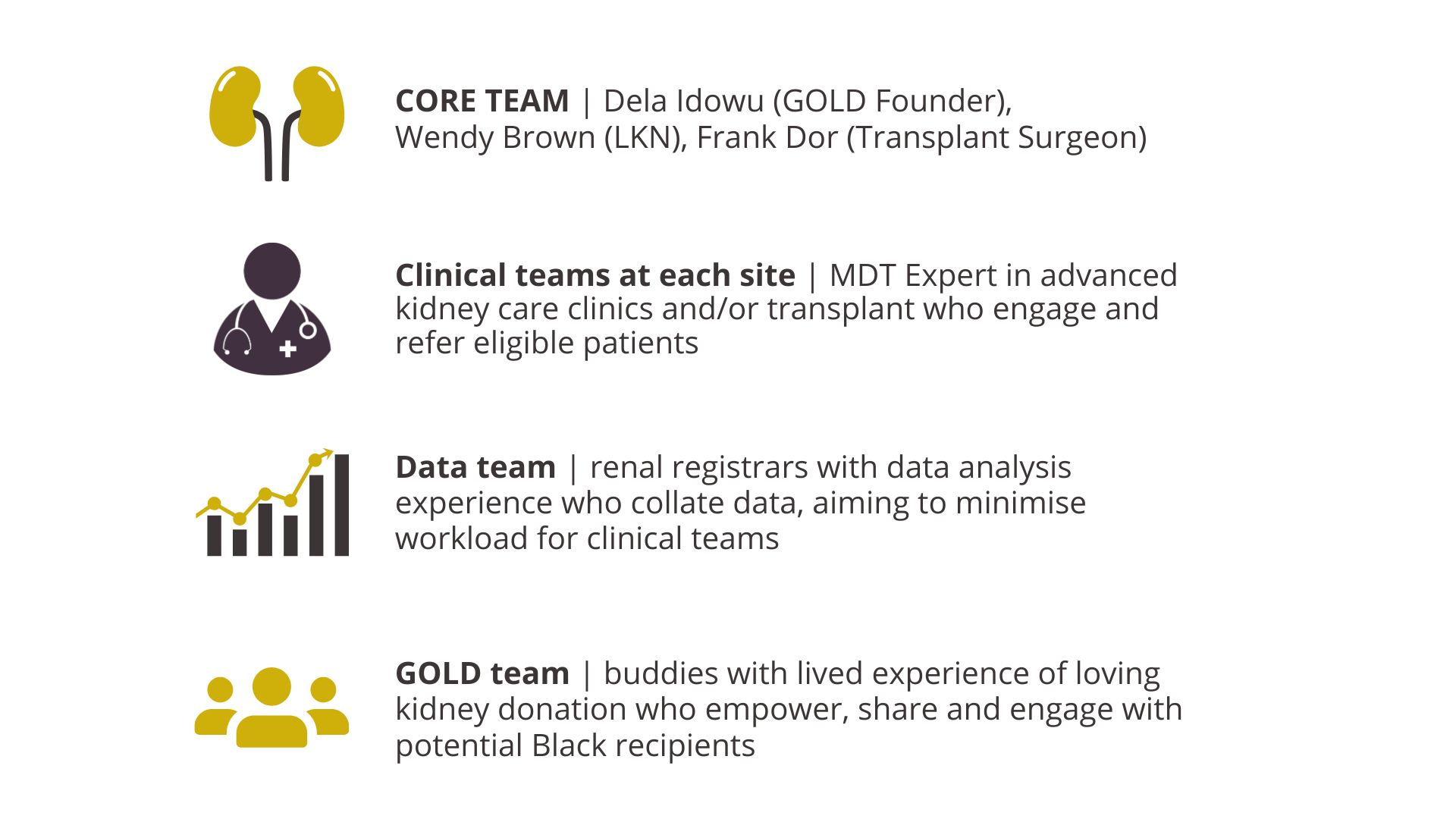
How is the QI project structured?
How do I start it in my centre?
To start a GOLD QI project in your centre, you need to:
- Identify a multidisciplinary clinical team based in transplant and/or advanced kidney care (two or more people)
- Identify someone to collect and report the data (we can help identify a trainee for this role)
- Complete centre-specific governance procedures such as registering the QI project and discussing with relevant departmental leads
How the GOLD QI team can help you
1
Getting started
We work with clinical teams to implement the scheme. Starting small, initially with a pathway (identified via process mapping) within your centre, before scaling up the project.
2
Data & Information
We’ll provide culturally tailored, patient literature and posters.
We work out how to operationalise data extraction with your nominated data lead for each site.
The data is recorded in a secured document stored in a shared NHS OneDrive account. A monthly report is shared with participating centres containing anonymised data.
3
Staying on track
Once you’ve launched your scheme, we advise clinical and data teams during monthly meetings, helping them to review progress and discuss challenges.
The GOLD team can join these meetings to help promote the project.
GOLD Buddy Scheme Testimonials
I felt the programme was relatively easy to implement and has changed the way I approach living donation with Black patients .
Vena Sinclair, CKD Nurse Specialist
This is a fantastic QIP which has improved outcomes and supported our Black patients.
Christopher Clarke, Lead Clinical Nurse Specialist, Pre and post Renal Transplant
This QIP is needed to increase patients and their loved ones’ awareness about LDKT and their options. I also believe that this OIP helped the clinical staff to appreciate the reality in terms of cultural differences and their impact on the chances for transplantation for black patients.
Cristina Horpos, Lead CNS for recipient and living donor team, MSc Advanced Nurse Practitioner
Community engagement, changing the conversation.
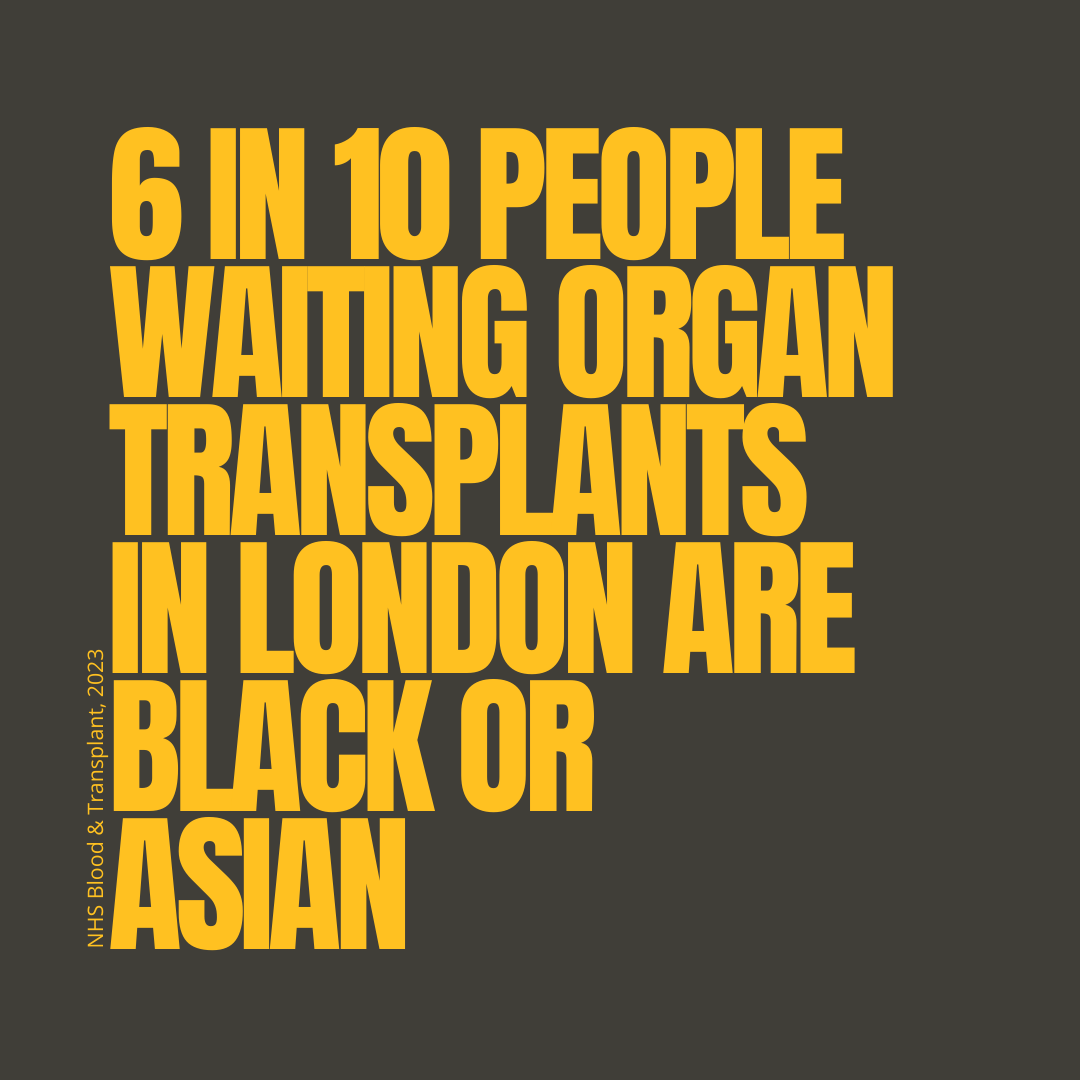
Latest data on living donor transplants for Black patients

Could you be a Phone Buddy?
Find out what you need to become a GOLD phone buddy÷